The intent of this blog was not meant to be topical. However, here in Canada there has, of late, been wide-spread talk about school dress-codes and how they affect young women in particular. And since my exposure to women's issues comes in no small part from my encounter with art history it occurred to me that my opinions on this patter have been partially formed by art.
I was lucky, in as much as I grew up in a context in which my mother (and step-mothers) were individuals with careers who did not, relatively speaking, fit into traditional women's roles. As a boy it never would have occurred to me that women were somehow less than men or should not receive the same rights and responsibilities in the work-force or in society in general. However, this attitude was, ironically, somewhat naive because I simply didn't realize, for a very long time, the depth of sexism and gender inequality in our society. My first real understanding began, I think, upon reading the work of John Berger, one of the great art historians of the 20th century. Chapter 3 of Berger's ground-breaking book Ways of Seeing, begins with this passage.
"According to usage and conventions which are at last being questioned but have by no means been overcome, the social presence of a woman is different in kind from that of a man. A man's presence is dependent upon the promise of power which he embodies. If the promise is large and credible his presence is striking. If it is small or incredible, he is found to have little presence. The promise of power may be moral, physical, temperamental, economic, social, sexual - but the object is always exterior to the man. A man's presence suggest what he is capable of doing to you or for you. His presence may be fabricated, in the sense that he pretends to be capable of what he is not. But the pretence is always toward a power which he exercises on others.
By contrast, a woman's presence expresses her own attitude to herself, and defines what can and cannot be done to her. Her presence is manifest in her gestures, voice, opinions, expressions, clothes, chosen surroundings, tastes - indeed there is nothing she can do which does not contribute to her presence. Presence for a woman is so intrinsic to her emanation, a kind o heat or smell or aura.
To be born a woman has been to be born, within an allotted and confined space, into the keeping of men. The social presence of women has developed as a result of their ingenuity in living under such tutelage within such a limited space. But this has been at the cost of a woman's self being split into two. A woman must continually watch herself. She is almost continually accompanied by her own image of herself. Whilst she is waling across a room or whilst she is weeping at the death of her father, she can scarcely avoid envisaging herself walking or weeping. From the earliest childhood she has been taught and persuaded to survey herself continually." (pages 45-46)
This remarkable passage was a revelation to me when I first read it as an art student, and its significance has grown on me ever since, particularly when I became a father. It made me realize the deep, structural, processes of sexism that are inherent in even our daily, seemingly prosaic actions. And this passage so expertly expresses one of the reasons that school dress-codes are so profoundly objectionable to me. I believe that anyone who imagines that school dress-codes treat girls and boys equally really isn't paying attention. But much more importantly, we must understand that even if school dress-codes were directed and enforced entirely equally in gender terms, their impact is fundamentally sexist. This sexism arises from the fact that, given the historical inequities and the psychological/ideological effects as outlined by Berger above, it is fundamentally different for a young woman to be 'told' what to wear and what not to wear than it is for a young man. For the young woman, such restrictions are a continuation of millennia of physical and psychological control. When a young woman is told that her thighs or her shoulders or her bra-straps are provocative and distracting to men, she is being told once again that she is an object of observation and she once again become an object of her own observation. She is compelled, once again, to survey herself, not as an individual whose presence and power is rooted in her potential for action or achievement, but as an image of gestures and body-parts, and clothes and expressions.
This is not to say that the elimination of dress-codes would magically solve the problems of gender inequality. Young men will, perhaps, always "look" at young women, and it will likely be a very long time before woman are not continually surveying themselves. And I don't believe that there is anything inherently "sexist" about sexual attraction. But if we want our daughters to grow up to be confident women of ability and achievement, we must stop the cycle of observation, surveillance, and control in which they are potentially mere 'distractions' for the male imagination. And this means that we must stop telling them what to wear and how to wear it.
Later in the same passage that I quoted above, Berger writes "one might simplify . . by saying: men act and women appear. Men look at women. Women watch themselves being looked at. This determines not only most relations between men and women but also the relation of women to themselves. The surveyor woman in herself is male: the surveyed female. Thus she turns herself into an object - and most particularly an object of vision: a sight." I couldn't think of a better expression of what is problematic about school dress-codes and why, regardless of intent, they continue to be fundamentally a reinforcement of gender inequality.
Thursday, June 12, 2014

Saturday, May 31, 2014
From Sketch to Finish. . . .
Then a problem arises; translating that drawing or sketch into a finished work. As almost any artist knows, pencil sketches almost always express a freedom and spontaneity that is very difficult to achieve in finished work. Some artists, like many of the Impressionists, painted with great speed outdoors on the spot so that they could get that spontaneity in the finished work. Some artists, on the other hand, might simply paint directly on the canvas with very little planing, thus doing in the studio what the Impressionist did in the field. But that approach simply is not practical for more "finished" or meticulous kinds of work. Many traditional painters were working on huge canvases with figures (sometimes many figures) in their paintings. Such paintings required detailed and meticulous planning. Think of paintings by Rubens or even John Everett Millias. Paintings by artists like these obviously couldn't be painted without sketches and planning. Benjamin Robert Haydon, one of history's more interesting artists, worked on one of his major works for over six years.
One of the most challenging processes of art in this sense must surely be Comic Book art. Though comic book figures are almost all done by a kind of consistent and reoccurring pattern, I have seen many finished comic books in which the drawings were obviously excellent, demonstrating motion and fluidity, but the inking process has essentially killed this spontaneity and the finished work just doesn't make it. My own father experienced this when he created the Steel Chameleon super hero in a comic book in the 1980s. On the other hand, Comic book art has the advantage in the fact that one can ink directly over the sketch, making the retention of spontaneity achievable. However, much comic book art is fundamentally about motion and movement so the challenge remains high.

I have struggled with this problem myself in different ways and on different occasions. Sometimes, it is quite straightforward, as in the case of this drawing of a Joshua tree which I then turned into a large painting.

 |
| And here is the finished Painting |
It still think that the drawing has a graphic charm that is missing in the painting in this case but the painting also has its advantages.
Sometimes the problems are more challenging. Here is a sketch and a painting that I recently completed.


In this case I really liked the drawing but something about the painting just didn't quite work for me.
In the next case I think the painting actually improved on the drawing. I am not sure how that happened, and it seems to be sadly rare.

In very rare cases I have used the simple technique of squaring a drawing off in order to replicate it very accurately on the board on which I am painting. This, technique works better, I think, with something like landscape painting. Here is a sketchbook drawing (which I took from a very small sketch that my father did) which I squared off for painting.
 |
| The blue paint smears on this drawing illustrate the chaos of the studio |

Here is one, more extreme, example. In this case the sketch was a very small drawing (about 2x4 inches) with very little detail, which was then worked up to a much larger (24x36 inches) oil painting. In this case I used an middle step which consisted of a coloured drawing of the idea.


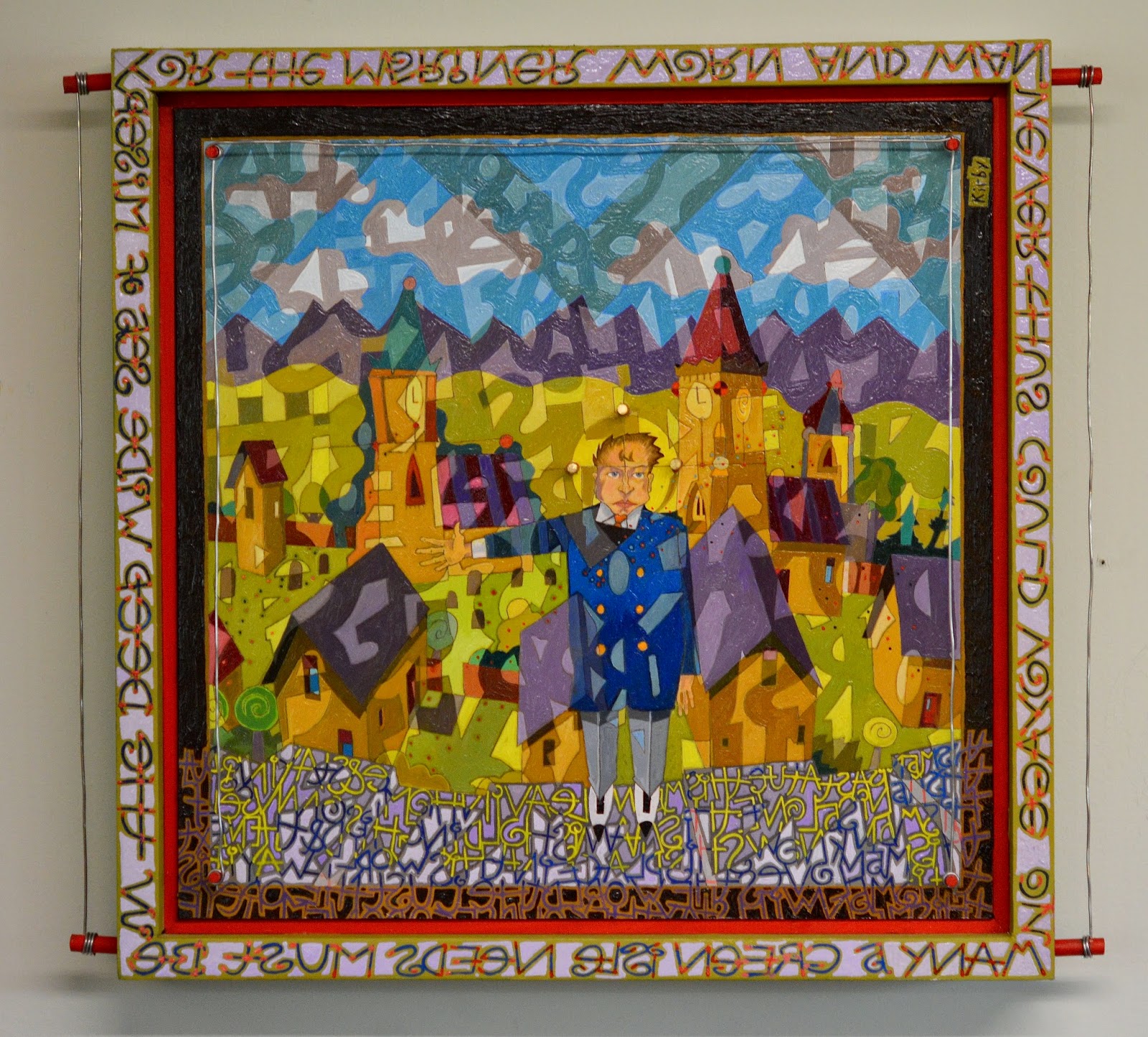
Here is an example of my 3-dimensional work which I just make the barest bones of a sketch idea and the rest is worked out as I build and paint the piece. It is somewhat ironic that these works are actually much more complicated and yet I don't seem to have an inclination to work out the details on paper. Instead, I think about these piece for a lot more time, working out most of the details in my head. Of course work like this is a much bigger commitment and this particular work is over 400 hours in the making.


These are just a few examples of the process from sketch to finished work. I am sure every artist has their own stories of success and failure when it comes to this process. It seems to me, after many years of experience, that every person has their own "natural" sense of colour and style which comes out in their art work without thought or plan. Some artist have a knack for doing very slick, commercially popular work (I don't mean this in a derogatory way) and they have certain advantages when it comes to certain kinds of work. Other artist may have a quirky charm about what they do, which may make commercial success more challenging but can also find a place. But regardless of your natural sense of colour and style, I think this problem of turning a sketch into a finished work is a universal dilemma.
Wednesday, April 30, 2014
Punch Magazine and the Golden Age. . . .
My father was born on Thursday, March 24, three days short of Easter in 1932. I am only aware of the proximity of his birth to Easter Sunday because of a cartoon that appeared in Punch Magazine on that week. Here is the cartoon.


*It should also be remembered that one of Punch's founding editors was Henry Mayhew who wrote one of the first effective sociological studies in English - London Labour and the London Poor. He was a man who knew first hand the terrible conditions in which many in England lived at that time.
The cartoon is by Bernard Partridge, an artist who became the chief cartoonist at Punch Magazine around 1910 and continued to do cartoons, book illustrations, and some paintings till his death in 1945. The cartoon is meant to illustrate the irregularity of the timing of the Easter Holiday, and though it is not particularly amusing, it is a nice drawing and, entirely unbeknownst to Mr. Partridge, it informed me of a little piece of trivia about my father's birth.
My dad loved Punch Magazine and left me a large collection of Punch books which are collections of cartoons and writings. Punch was one of the longest running magazines of England. Punch published from 1841 to 2002 and some great writers were involved in it pages including my very favourite writer E.V. Lucas. One of the most interesting aspects of Punch is that, in a country so infected by class distinctions, it crossed over class fairly effectively. Punch was by no means a radical publication, but one of the very first editions of Punch contained Thomas Hood's great poetic indictment of English Capitalism "The Song of the Shirt" which was transformed into a popular song and was an integral piece of the cultural puzzle leading to labour reforms.* Punch seemed to appeal to people of all walks of life and in it offices were brought together working-class writers and artists as well as wealthy ones. My father was very working-class but he always enjoyed Punch not only as an artist but as someone who enjoyed good and amusing prose.
Punch is probably more remembered for the artwork that appeared on its pages than for the great prose. One of Punch's greatest artists, Charles Keene, was a globally admired etcher and pen and ink artist who was so effective (so the legend goes) that he was a significant influence on great painters of the 19th century. Here is an example of Keene's work.
But Charles Keene was of the 19th century in style and Bernard Partridge, though a good draughtsman, often produced rather stiff and overly heavy work. My father's personal favourite Punch cartoonist was unquestionably the great Phil May. Though May died in 1903, his style was revolutionary and he introduced a real 20th century style. May eschewed the traditional pen and ink approach and invented a simplified, fluid style that gives him a very important place in the history of cartooning and drawing in general. (I was lucky enough to inherit an original Phil May cartoon from my dad) Take a look at this drawing which is remarkably open and minimal for a 19th century work in pen and ink.
My dad was particularly attracted to Phil May because he often portrayed working-class, cockneys on the streets of London in sympathetic, amusing ways. May's "Gutter-snipe" series is a genuine and important historical record of working-class culture.
My favourite Punch cartoonist of the golden age is, without a doubt, Frank Reynolds. Reynolds was a remarkable draughtsman and could draw better than almost anyone I have ever seen. He was, for a number of years, the art editor of Punch as well as a prolific watercolour painter. Here is one of my favourite Reynolds cartoons from the pages of Punch.
Punch is gone now. But more importantly, the era of drawing is largely gone. When I was in art college I was a drawing major and I spent years trying to continually improve my drawing skills. And even though my work doesn't generally involve complex, realistic drawings, I know that the skill helps me in every kind of artwork. But we live in a different era today and most artwork I see is woefully inadequate from a drawing point of view. It is unfortunate because I often see paintings, for example, in which the message is significantly let down by the artist's inability to draw effectively. This situation has gotten so dramatic that I believe that much of the time artists don't even know when their drawing skills are lacking. But we live in an age of short-hand, and the skills that were once considered "basic" for an artist are being replaced by more complex computer and digital skills. So it goes.
But I have digressed. I read Punch collections regularly for the enjoyment of the drawings, the humour, and the excellent prose. But I also look at such books as a way of connecting me to the past. The pages of Punch connect me to my father (as the Bernard Partridge example so effectively illustrates) and to the writing, art, and culture of the past.
*It should also be remembered that one of Punch's founding editors was Henry Mayhew who wrote one of the first effective sociological studies in English - London Labour and the London Poor. He was a man who knew first hand the terrible conditions in which many in England lived at that time.
Tuesday, April 22, 2014
The Dilemma of Painting's Function. . . .
There are a seemingly countless number of motivations for producing and consuming art in the modern world. For some, art is a form of escape and pure entertainment. Others want art to challenge their world view and stir them from complacency. Art can be an act of personal therapy or a revolutionary effort. This variety in art's function and meaning led German philosopher Theodor Adorno to open his book of aesthetic theory with the observation that "today, it goes without saying that nothing about art goes without saying." However, for much of the history of the arts it could be argued that they have had a primary function that is generally instructive, at least in an abstract sense. Before the modern era much of that which we now call "art" (that is to say that which functioned beyond what we now refer to as craft) was religious or moralistic in nature. From renaissance painting to 19th century moralist novels, art has often served a fairly didactic role. Even Romantic poetry was often perceived to have an ethical function by many of its practitioners. Shelley was a master of cadence and lyrical verse, but he didn't write poetry for poetry's sake. Even the shorter poems among his masterpieces, such as the brilliant "Lines Written Among the Euganean Hills" is meant to teach its reader about life. Consider the opening lines -
Many a green isle needs must be
In the deep wide sea of misery -
Or the mariner, worn and wan,
Never thus could voyage on.
If we return to Ruskin, who I have been discussing recently, we can see that one of the reasons for his significant success is found, as George Landow has pointed out, in his ethical, sermonic style which appealed to his moralistic, Victorian readers. Even today, though a didactic concept of art is decidedly unfashionable, many people read novels in a rather instructive way. I obviously don't mean to imply that people are expecting their novels to teach them how to use a smart-phone or change a tire. But they do seem to expect their novels to be more than mere entertainment, and often look for stories to demonstrate how people navigate the complex moral dilemmas and social intricacies in their lives as though they are reading an abstract form of self-help book.
Within the field of visual art there is a long history of instructive material. From renaissance paintings that illustrate biblical stories to the instructions on how to construct Ikea furniture, there are many examples of visual art performing a specifically didactic function. This is a realm of art that was compellingly addressed by James Elkins in his 1999 book The Domain of Images. However, since the modern era, I think it is safe to say that, in terms of instructive power, the primary visual "high" art has been at something of a disadvantage compared to art forms such as, say, literature or theatre. Instead of embracing a directly didactic function, many people see visual art in terms of the ways in which it can raise the profundity of our thoughts and seize upon the sublimity of the natural world. Indeed, this is precisely what Ruskin imagined that the essential role of great art to be. (Obviously the more 'commercial' visual art forms are an entirely different story)
To return to where I began, I would say that these issues raise a dilemma that has faced art in general, but most specifically visual art, since the beginning of the modern age; the dilemma of function. When the specifically religious function of visual art began to disappear, visual art (specifically painting) became more or less the handmaiden of rich and powerful. In terms of its necessary social investment, painting is very expensive; it takes a long time to train a painter and most paintings are very labour intensive. This relative social expense made "fine" art the domain of only the few who could afford the investment. With the growth of the middle-class, the possible audience for 'fine' art expanded somewhat and many painters turned to decorative art (landscapes in particular) as a possible outlet for an artistic career.* But as Romantic ideology became ingrained in the culture of art, and art became more and more a question of personal expression, the function of painting became increasingly problematic. This dilemma is characterized by the fact that we have had generations of 'fine' artists who have overwhelmingly operated in isolation and anonymity. The reason for this dilemma goes back to the issue with which I began this discussion - didacticism. I think it is relatively straightforward for novels, films, theatre, or even video games to serve multiple functions. Such art forms can easily be personal expressions of their authors, entertainments, cultural documents, and morally instructive all at the same time. However, this multi-functional effort seems to be a much more difficult project for a painting. In other words, though visual art in the so-called commercial field is remarkably dynamic in its possible functions, an art form like painting is quite limited in scope compared to other art forms.
Now this a significantly truncated argument and one could write a large book fleshing out the issues raised here such as the relationship between the rise of Romanticism and capitalism, the so-called "free-market" and the emphasis on individual creativity, etc. But I think the core of the argument is fairly basic - an art form like painting, with its inherent narrative limits and its stress on the individual creative process has a difficult time thriving in a modern, technologically driven culture and market, particularly given the versatility of other art forms which can be at once didactic (or perhaps we should say 'informative'), technologically engaging, entertaining, seductively decorative, and simultaneously universal as well as personal.
I have my own, deeply personal, reasons for painting, and I don't kid myself that in an age of video games, block-buster movies, and e-readers, that painting could ever wield the kind of cultural currency that it once had. Of course, with the right recipe of luck and salesmanship, one could still earn a good living painting pictures. But like many time consuming crafts, painting is increasingly a marginalized activity. I suspect that in a world dominated by impersonal mass-production, some people will come to cherish the few things that can still have that human touch. But that will never really take art forms like painting out of the shadows of the global marketplace. As an advocate of the arts and crafts movement, I am certain that Ruskin would be horrified by the modern culture of mass-production. He wanted art to be not only a personal expression but an expression that lifted peoples lives and consciousness onto a higher plane, not only to demonstrate what we are but to demonstrate what we might become.
It is interesting that we spend thousands of dollars on objects in our lives (such as cars, computers, and cell phones) that are more or less disposable. And yet very few people go out and purchase art which is usually something that can last your own lifetime as well as the lifetimes of many of your decedents. Similarly, it is amazing that people still routinely buy paperback books that are often destroyed after one reading while the internet now gives us access to countless high-quality, well bound, hard-cover books for very reasonable prices. I suspect that the reasons for this phenomenon is fairly straightforward; in a milieu of the speed and movement that comes with computer technology, we have begun to see the function of the arts as basically disposable like everything else. Films of remarkable quality come and go over a weekend. Books appear on our e-readers and then disappear. We are served a gluttonous diet of millions of visual images everyday that are like ghost in a digital dimension. When we have lost the aura that is associated with objects of art or craft, we have also largely lost our desires to preserve objects such as paintings and the lifetimes of pleasure that they can bring.
*It is interesting that one of the primary reactions to the functional dilemma of 'fine' art was the arts and crafts movements (led in large part by William Morris) which sought to deal with the declining importance of painting that came with capitalism and secularization by bringing painting back to a craft base.
Many a green isle needs must be
In the deep wide sea of misery -
Or the mariner, worn and wan,
Never thus could voyage on.
If we return to Ruskin, who I have been discussing recently, we can see that one of the reasons for his significant success is found, as George Landow has pointed out, in his ethical, sermonic style which appealed to his moralistic, Victorian readers. Even today, though a didactic concept of art is decidedly unfashionable, many people read novels in a rather instructive way. I obviously don't mean to imply that people are expecting their novels to teach them how to use a smart-phone or change a tire. But they do seem to expect their novels to be more than mere entertainment, and often look for stories to demonstrate how people navigate the complex moral dilemmas and social intricacies in their lives as though they are reading an abstract form of self-help book.
Within the field of visual art there is a long history of instructive material. From renaissance paintings that illustrate biblical stories to the instructions on how to construct Ikea furniture, there are many examples of visual art performing a specifically didactic function. This is a realm of art that was compellingly addressed by James Elkins in his 1999 book The Domain of Images. However, since the modern era, I think it is safe to say that, in terms of instructive power, the primary visual "high" art has been at something of a disadvantage compared to art forms such as, say, literature or theatre. Instead of embracing a directly didactic function, many people see visual art in terms of the ways in which it can raise the profundity of our thoughts and seize upon the sublimity of the natural world. Indeed, this is precisely what Ruskin imagined that the essential role of great art to be. (Obviously the more 'commercial' visual art forms are an entirely different story)
To return to where I began, I would say that these issues raise a dilemma that has faced art in general, but most specifically visual art, since the beginning of the modern age; the dilemma of function. When the specifically religious function of visual art began to disappear, visual art (specifically painting) became more or less the handmaiden of rich and powerful. In terms of its necessary social investment, painting is very expensive; it takes a long time to train a painter and most paintings are very labour intensive. This relative social expense made "fine" art the domain of only the few who could afford the investment. With the growth of the middle-class, the possible audience for 'fine' art expanded somewhat and many painters turned to decorative art (landscapes in particular) as a possible outlet for an artistic career.* But as Romantic ideology became ingrained in the culture of art, and art became more and more a question of personal expression, the function of painting became increasingly problematic. This dilemma is characterized by the fact that we have had generations of 'fine' artists who have overwhelmingly operated in isolation and anonymity. The reason for this dilemma goes back to the issue with which I began this discussion - didacticism. I think it is relatively straightforward for novels, films, theatre, or even video games to serve multiple functions. Such art forms can easily be personal expressions of their authors, entertainments, cultural documents, and morally instructive all at the same time. However, this multi-functional effort seems to be a much more difficult project for a painting. In other words, though visual art in the so-called commercial field is remarkably dynamic in its possible functions, an art form like painting is quite limited in scope compared to other art forms.
Now this a significantly truncated argument and one could write a large book fleshing out the issues raised here such as the relationship between the rise of Romanticism and capitalism, the so-called "free-market" and the emphasis on individual creativity, etc. But I think the core of the argument is fairly basic - an art form like painting, with its inherent narrative limits and its stress on the individual creative process has a difficult time thriving in a modern, technologically driven culture and market, particularly given the versatility of other art forms which can be at once didactic (or perhaps we should say 'informative'), technologically engaging, entertaining, seductively decorative, and simultaneously universal as well as personal.
I have my own, deeply personal, reasons for painting, and I don't kid myself that in an age of video games, block-buster movies, and e-readers, that painting could ever wield the kind of cultural currency that it once had. Of course, with the right recipe of luck and salesmanship, one could still earn a good living painting pictures. But like many time consuming crafts, painting is increasingly a marginalized activity. I suspect that in a world dominated by impersonal mass-production, some people will come to cherish the few things that can still have that human touch. But that will never really take art forms like painting out of the shadows of the global marketplace. As an advocate of the arts and crafts movement, I am certain that Ruskin would be horrified by the modern culture of mass-production. He wanted art to be not only a personal expression but an expression that lifted peoples lives and consciousness onto a higher plane, not only to demonstrate what we are but to demonstrate what we might become.
It is interesting that we spend thousands of dollars on objects in our lives (such as cars, computers, and cell phones) that are more or less disposable. And yet very few people go out and purchase art which is usually something that can last your own lifetime as well as the lifetimes of many of your decedents. Similarly, it is amazing that people still routinely buy paperback books that are often destroyed after one reading while the internet now gives us access to countless high-quality, well bound, hard-cover books for very reasonable prices. I suspect that the reasons for this phenomenon is fairly straightforward; in a milieu of the speed and movement that comes with computer technology, we have begun to see the function of the arts as basically disposable like everything else. Films of remarkable quality come and go over a weekend. Books appear on our e-readers and then disappear. We are served a gluttonous diet of millions of visual images everyday that are like ghost in a digital dimension. When we have lost the aura that is associated with objects of art or craft, we have also largely lost our desires to preserve objects such as paintings and the lifetimes of pleasure that they can bring.
*It is interesting that one of the primary reactions to the functional dilemma of 'fine' art was the arts and crafts movements (led in large part by William Morris) which sought to deal with the declining importance of painting that came with capitalism and secularization by bringing painting back to a craft base.
Tuesday, April 15, 2014
Further Thoughts on Ruskin. . .
In my last blogpost I briefly addressed the issues
surrounding the British Art/Social critic John Ruskin. A very old friend of
mine, for whom I have a great deal of respect, was kind enough to repost that
post on Facebook. A mutual friend of ours from our college days then made a
lengthy comment on it, in which he felt that he needed to come to the defence
of poor Ruskin. Why exactly he felt compelled to defend the old man of
Brantwood escaped me entirely. Nothing I said about Ruskin was particularly
controversial. I wasn’t by any means harsh on him, nor did I offer any opinions
that have not been made before by people eminently more qualified than myself.
Thus, I was surprised when this old acquaintance posted a defensive panegyric
of Ruskin coupled with an ad homonym critique of me, calling me, and my opinion
of Ruskin, “capricious.” My own capriciousness aside (and perhaps it is a fair
claim), it is not entirely clear that an opinion, in and of itself, can be
properly characterized by this adjective. In order to determine the
capriciousness of my opinion of Ruskin, one would be required, at the very
least, to have a point of comparison, which, not having talked to me about this
or anything else in nearly 30 years, he decidedly did not.
However, these comments, though only superficially informed,
got me thinking more closely about the problems we face when thinking about a
19th century critic like Ruskin. I wrote there that I thought that
Ruskin’s ideas lacked “rigour.” And though I was not clear about what this
meant, I stand by that opinion. I refer to Ruskin as lacking rigour not because
he is not thorough, but rather because he depends on vague, meta-concepts about
which there is no common agreement. In Ruskin’s mind, for example, great
landscape painting is that which properly expresses the sublimity of God’s
creation, and great art is that which reflects a certain ethical construct. One
needn’t be a philosopher to understand that such concepts are overwhelmingly
ambiguous. For such ideas to form part of a rigorous argument they would have
to be subject to general agreement in some form. I understand, I think, what
Ruskin is trying to get at some level, but the problem here is not really
understanding. Ruskin was not simply trying to state his opinion, per se, he
was attempting to establish a qualitative notion of art. But establishing such
a theory would require agreement about the function of art as well as the
subsequent criteria for quality. And agreement on such issues simply don’t
prevail, let alone consensus about the nature of God or properly ‘ethical’
behaviour.
This problem is by no means exclusive to Ruskin. In fact, it
is characteristic of most aesthetic philosophers. It is for this reason that
qualitative theories about art largely disappeared in the 20th
century. (Indecently, these points apply even more pointedly to literary
theory) Meta-theories of art have been largely replaced by straight up
commentary, or, at most, inter-subjective critiques of art. By
inter-subjective, I mean criticizing a work of art within certain, already
basically agreed upon standards. (In this sense I could, for example, critique
a film by placing it squarely within a genre and then comparing it to what
advocates of that genre believe are effect expressions of that particular genus
of film.
I must admit that despite my somewhat ‘post-modern’ and
relativistic outlook, I like Ruskin. I think my appreciation comes from the
fact that I sympathize with his project of finding a qualitative theory of art.
Justice Potter Stewart of the US Supreme Court once said (to paraphrase) that
he couldn’t successfully define obscenity but he knew it when he saw it. I
often feel the same about good art. Like a true Romantic, I want to believe
that ‘great’ art is out there. It is a strange, inexplicable combination of
technical skill, originality, and profound thought. The problem is that, if I
am intellectually honest with myself, I am pretty sure none of these ideas can
be properly defined, so like Justice Stewart, I am stuck with a platitude. And
in the end, much of Ruskin’s great text Modern Painters, is just a wonderful, seductively
eloquent platitude.
Wednesday, April 9, 2014
John Ruskin and the Problem of Taste. . .
I recently hit upon the idea of reading through the entire text of John Ruskin's Modern Painters. I know, it sounds crazy in the age of text messaging and audio books to actually read a five volume, 19th century text about art written in a convoluted, 18th century style. But I live on the edge, I am a daredevil. I once read an version of this book that had been edited to the bare bones of what the editor believed to be the most important excerpts - a sort of Ruskin's greatest hits. However, I decided that the time had come to take the aesthetic plunge, so to speak, and read the entire five volumes, in order to see if Ruskin's massive reputation has been well deserved.

Ruskin is often, if not usually, considered to be the most important anglo art critic of the 19th century. He is, perhaps, most renowned for his spirited defence of Turner at a time when that artist was being widely vilified. Or, perhaps, he is most famous for his rather spirited attack on the work of James Whistler and the libel case that ensured.
Ruskin suffered a number of personality drawbacks, for want of a better phrase, which has left his reputation in something of a dodgy state with many. It has often been said that he was unable to consummate his marriage with Effie Gray because his delicate sensibilities were offended at the sight of a woman in the flesh. It seems that Ruskin's only experience with a naked woman was with marble statues, which are considerably smoother and more "ideal" than the body of a "real" woman. (Most importantly for Ruskin was, perhaps, his surprise in discovering that women, unlike marble sculptures, had body hair). Luckily for Effie, she eventually married the painter John Everett Millais, bore him eight children and seems to have had a relatively happy life. Another problem which Ruskin displayed was a typically aristocratic pompousness and overwrought sense of self-importance. Once Ruskin was convinced of the correctness of one of his philosophical postulations, he was unable to brook disagreement.
Unfortunately for Ruskin he suffered from mental illness as he aged, (what some now believe to have been Cadasil Syndrome), and he gradually degenerated into a state of mental incapacity.
Despite his drawbacks and weaknesses, Ruskin was a profoundly interesting man. He was not only an important art critic, but he was a champion of the Arts and Crafts movement, and wrote fairly extensively about politics and society. His interesting, if somewhat naive, book Unto This Last, was an important document concerning his belief in the importance of social cooperation and the evils of industrial capitalism. Furthermore, it was a book that had a profound influence on the life of Mahatma Gandhi, who read it when he lived in South Africa and patterned much of his future political/social efforts on it.
Modern Painters was written by Ruskin in the 1840s and is considered by many to be one of the more important texts on art ever written. And though I have not gone all the way through it yet, I would say, on first blush, that it is a fairly difficult text for a 21st century reader to appreciate. It makes explicit appeals to religion which probably seem antiquated for many today and it lacks intellectual rigour. Like so many books on art, it makes huge assumption that lack argument and in the end it seems to come off, at least in part, as a very elaborate justification of a man's personal aesthetic taste. The crux of Ruskin's whole intellectual problems can be highlighted in a number of places in the first part of the first volume. I was particularly struck by the following passage made in Ruskin's preliminary discussion of the basis of art.
"Ideas of beauty, then, be it remembered, are the subjects of moral, but not intellectual, perception. By the investigation of them we shall be led to the knowledge of the ideal subjects of art."
Herein, as they say, lies the rub. One could easily argue that both of the above statements cannot be true, they are mutually exclusive. If, as Ruskin says, ideas of beauty are really subjects of moral perception, then we would be unable to properly investigate them (or at least decide upon any 'objective' truth about them) through a process of intellectual investigation. In other words, if notions of beauty are really moral, or ethical matters, they will continually resist intellectual investigations. Put more explicitly, they will never be decided in any objective sense through rational discourse.
To put this more clearly, since no universal agreement can be found concerning ethical or normatively 'correct' behaviour, an art theory which considers art or beauty in an ethical light, will wield little to intellectual investigations. In other words, what Ruskin has done is to champion a non-rigorous, irrational field of human endeavour, to wit - morals, and then suggested that through intellectual investigations we will be able to decide upon this non-intellectual notion.
Now, some people might react to this discourse and say "Hold on here. Moral or ethical questions are not immune to intellectual investigation." And of course they are not. We might engage in a rational investigation of what someone's moral standards are. And we might, in a pinch, come to decide upon how they came about those standards. However, in the end, the correctness or incorrectness of someone's morals is not really subject of objective, intellectual discovery. Similarly, if we imagine, at some level, that a 19th century art critic like Ruskin is ultimately concerned with deciding upon the "value" or "quality" of a work of art and taste in general, then he runs into a major problem when he a priori decides that questions of beauty are really only questions of morals.
This problem goes to the very heart of much art theory and criticism. Many people talk about art in a purely exploratory manner. We can explore things like how the art affects us, what kinds of traditions the art exists in, what artists have been an influence in its production, social reception of art, etc., etc. However, obvious, and very profound problems arise when we try to make decisions about the quality of art. (Anyone who has read Zen and the Art of Motorcycle Maintenance knows this well.) Can we decide upon the quality of art beyond the relatively simple questions of skill or power of execution?? I have been investigating and thinking about this problem for over thirty years and I am no closer to a solution today than I was at the beginning.
A critic like Ruskin is convinced that he knows what constitutes "good" taste and "good" art. To justify his opinions he brings in all sorts of spiritual, religious, and moral ideas that not only seem somewhat antiquated to readers today, but are also entirely subjective matters. This is not to say that Modern Painters is a waste of paper. There is a great deal of interesting historical and semi-technical information to be found in its pages. And besides those important incentives to read Modern Painters, it must not be forgotten that Ruskin is a VERY good writer with eloquent (albeit somewhat old-fashioned) prose. If you like fine 19th century English prose, you will find few writers to rival Ruskin.
Ruskin is often, if not usually, considered to be the most important anglo art critic of the 19th century. He is, perhaps, most renowned for his spirited defence of Turner at a time when that artist was being widely vilified. Or, perhaps, he is most famous for his rather spirited attack on the work of James Whistler and the libel case that ensured.
Ruskin suffered a number of personality drawbacks, for want of a better phrase, which has left his reputation in something of a dodgy state with many. It has often been said that he was unable to consummate his marriage with Effie Gray because his delicate sensibilities were offended at the sight of a woman in the flesh. It seems that Ruskin's only experience with a naked woman was with marble statues, which are considerably smoother and more "ideal" than the body of a "real" woman. (Most importantly for Ruskin was, perhaps, his surprise in discovering that women, unlike marble sculptures, had body hair). Luckily for Effie, she eventually married the painter John Everett Millais, bore him eight children and seems to have had a relatively happy life. Another problem which Ruskin displayed was a typically aristocratic pompousness and overwrought sense of self-importance. Once Ruskin was convinced of the correctness of one of his philosophical postulations, he was unable to brook disagreement.
Unfortunately for Ruskin he suffered from mental illness as he aged, (what some now believe to have been Cadasil Syndrome), and he gradually degenerated into a state of mental incapacity.
Despite his drawbacks and weaknesses, Ruskin was a profoundly interesting man. He was not only an important art critic, but he was a champion of the Arts and Crafts movement, and wrote fairly extensively about politics and society. His interesting, if somewhat naive, book Unto This Last, was an important document concerning his belief in the importance of social cooperation and the evils of industrial capitalism. Furthermore, it was a book that had a profound influence on the life of Mahatma Gandhi, who read it when he lived in South Africa and patterned much of his future political/social efforts on it.
Modern Painters was written by Ruskin in the 1840s and is considered by many to be one of the more important texts on art ever written. And though I have not gone all the way through it yet, I would say, on first blush, that it is a fairly difficult text for a 21st century reader to appreciate. It makes explicit appeals to religion which probably seem antiquated for many today and it lacks intellectual rigour. Like so many books on art, it makes huge assumption that lack argument and in the end it seems to come off, at least in part, as a very elaborate justification of a man's personal aesthetic taste. The crux of Ruskin's whole intellectual problems can be highlighted in a number of places in the first part of the first volume. I was particularly struck by the following passage made in Ruskin's preliminary discussion of the basis of art.
"Ideas of beauty, then, be it remembered, are the subjects of moral, but not intellectual, perception. By the investigation of them we shall be led to the knowledge of the ideal subjects of art."
Herein, as they say, lies the rub. One could easily argue that both of the above statements cannot be true, they are mutually exclusive. If, as Ruskin says, ideas of beauty are really subjects of moral perception, then we would be unable to properly investigate them (or at least decide upon any 'objective' truth about them) through a process of intellectual investigation. In other words, if notions of beauty are really moral, or ethical matters, they will continually resist intellectual investigations. Put more explicitly, they will never be decided in any objective sense through rational discourse.
To put this more clearly, since no universal agreement can be found concerning ethical or normatively 'correct' behaviour, an art theory which considers art or beauty in an ethical light, will wield little to intellectual investigations. In other words, what Ruskin has done is to champion a non-rigorous, irrational field of human endeavour, to wit - morals, and then suggested that through intellectual investigations we will be able to decide upon this non-intellectual notion.
Now, some people might react to this discourse and say "Hold on here. Moral or ethical questions are not immune to intellectual investigation." And of course they are not. We might engage in a rational investigation of what someone's moral standards are. And we might, in a pinch, come to decide upon how they came about those standards. However, in the end, the correctness or incorrectness of someone's morals is not really subject of objective, intellectual discovery. Similarly, if we imagine, at some level, that a 19th century art critic like Ruskin is ultimately concerned with deciding upon the "value" or "quality" of a work of art and taste in general, then he runs into a major problem when he a priori decides that questions of beauty are really only questions of morals.
This problem goes to the very heart of much art theory and criticism. Many people talk about art in a purely exploratory manner. We can explore things like how the art affects us, what kinds of traditions the art exists in, what artists have been an influence in its production, social reception of art, etc., etc. However, obvious, and very profound problems arise when we try to make decisions about the quality of art. (Anyone who has read Zen and the Art of Motorcycle Maintenance knows this well.) Can we decide upon the quality of art beyond the relatively simple questions of skill or power of execution?? I have been investigating and thinking about this problem for over thirty years and I am no closer to a solution today than I was at the beginning.
A critic like Ruskin is convinced that he knows what constitutes "good" taste and "good" art. To justify his opinions he brings in all sorts of spiritual, religious, and moral ideas that not only seem somewhat antiquated to readers today, but are also entirely subjective matters. This is not to say that Modern Painters is a waste of paper. There is a great deal of interesting historical and semi-technical information to be found in its pages. And besides those important incentives to read Modern Painters, it must not be forgotten that Ruskin is a VERY good writer with eloquent (albeit somewhat old-fashioned) prose. If you like fine 19th century English prose, you will find few writers to rival Ruskin.
Wednesday, April 2, 2014
What, if anything, does artwork say?
In March of 1922 Lord Northbourne, a painter and etcher in his own right, sent a letter to my favourite author, E.V. Lucas in which he made the following observation: ". . . . I venture to suggest that you are on unsafe ground when you judge of an artist's temperament and personality by the characteristics of his work! It is of course an amusing and innocuous pastime, but in real life nothing has seemed stranger to me than the difference which I constantly observe between a man's work and the man himself. // I have noticed in particular that the people who paint very placid pictures are usually nervous, irritable and overstrung - perhaps they paint such pictures as antidotes? Also sometimes swashbuckling palette-knifey and brutal painters are in real life very like rabbits, or even guinea-pigs! etc., etc." Since this is the only segment of the letter which E.V. Lucas published, I can only surmise that this letter was written by Northbourne in response to Lucas' recently published, and subsequently very popular, book on Vermeer. I don't have this book readily at hand but given the remarkable placidity of Vermeer's amazing paintings I imagine that Lucas there made some strong supposition about the painter's personality.
.jpeg)
It is easy to imagine even a rigorous historian making suppositions about the personality of the man who painted pictures like this one. Furthermore, E.V. Lucas is exceptionally placid and good-humoured in his writing and if he were going to make generalizations about someone, such assumptions would likely err on the side of serenity and quietude.
Obviously, assumptions about someone's personality are, under any circumstances, questionable. After all, most people's personalities are not easily generalized. This fact does not, of course, prevent us from continually engaging in such generalizations. W.C. Fields was a curmudgeon, van Gogh was an emotional volcano, etc., etc. And though I don't want to deny that such generalizations are ever possible, or, indeed, useful, they are notoriously difficult to make, particularly about historical figure, people on who we largely rely upon others for our information. And of course, when we talk about someone like Vermeer, it is exceptionally difficult to make generalizations because we know so very little about him. In fact, Vermeer has been called "the Sphinx of Delft" because his life is such a mystery. Thus, talking about Vermeer's personality is an exercise in pure speculation (albeit interesting and entertaining speculation).
I am sure that all of us who produce art wonder what other might think that our work says about us as individuals. In fact most artists I have met are obsessed by the notion because, in the final analysis, it is precisely ego that drives the majority of artists. Well, I never talk about the meaning of my work and almost never talk about its content. And one of the simplest reasons for this is that such talk gets in the way of a viewer's response. I am sure that the content of someone's work does indeed say things about them as people, but exactly what is says should be left up to those who look at it.
With that in mind, here is the earliest of my paintings that I still possess, painted when I was 14 years old. (It is a watercolour and measures about 8 by 9 inches.)


It is easy to imagine even a rigorous historian making suppositions about the personality of the man who painted pictures like this one. Furthermore, E.V. Lucas is exceptionally placid and good-humoured in his writing and if he were going to make generalizations about someone, such assumptions would likely err on the side of serenity and quietude.
Obviously, assumptions about someone's personality are, under any circumstances, questionable. After all, most people's personalities are not easily generalized. This fact does not, of course, prevent us from continually engaging in such generalizations. W.C. Fields was a curmudgeon, van Gogh was an emotional volcano, etc., etc. And though I don't want to deny that such generalizations are ever possible, or, indeed, useful, they are notoriously difficult to make, particularly about historical figure, people on who we largely rely upon others for our information. And of course, when we talk about someone like Vermeer, it is exceptionally difficult to make generalizations because we know so very little about him. In fact, Vermeer has been called "the Sphinx of Delft" because his life is such a mystery. Thus, talking about Vermeer's personality is an exercise in pure speculation (albeit interesting and entertaining speculation).
I am sure that all of us who produce art wonder what other might think that our work says about us as individuals. In fact most artists I have met are obsessed by the notion because, in the final analysis, it is precisely ego that drives the majority of artists. Well, I never talk about the meaning of my work and almost never talk about its content. And one of the simplest reasons for this is that such talk gets in the way of a viewer's response. I am sure that the content of someone's work does indeed say things about them as people, but exactly what is says should be left up to those who look at it.
With that in mind, here is the earliest of my paintings that I still possess, painted when I was 14 years old. (It is a watercolour and measures about 8 by 9 inches.)
And here is my latest painting, completed yesterday. (It is an oil painting on wood that measures about 24 by 18 inches.)
I am not sure that these say anything conclusive about me as a person. But before you judge, keep in mind that they are done by the same hand that did this drawing when I was 20.
Though there is some dispute about who said it, I leave you with the quote - "If you want to send a message, use Western Union."
Subscribe to:
Posts (Atom)