For reasons that I am unable to articulate, I stopped painting a couple of months ago. I wish I could explain why, but I don't even understand it myself. Suffice to say that after 35 years for continually working as an artist, I ran out of steam, faith, and inspiration. It has been a significantly depressing and stressful process. In order to deal with it I started writing about life and art. And, of course, reading is always an essential concomitant of writing. Most of my fiction reading for the past twenty years or so has been 19th century and early 20th century work, but I recently started reading contemporary fiction again. After years of reading mostly older fiction, it is quite interesting to read newer books for a while.
The first book I picked up was one that I had read twice before - Robert Persig's Zen and the Art of Motorcycle Maintenance. Since it was published in the 1970s, this book has become a kind of modern classic, I think in large because it expressed the immense crisis in the Western psyche that was occurring in the lead up to the 70s. Though it doesn't specifically address these issues in any kind of systematic ways, Motorcycle Maintenance was written against the backdrop of the breakdown of traditional rationality, the linguistic turn in philosophy, the abandonment of so-called meta-theories, and rise of contemporary philosophical pragmatism. I read this book in the 1980s, in the 90s, and now again. Thought parts of it seem dated, an inevitability with any philosophical/fictionary work, it holds up well overall and it is an enjoyable read. Persig really illustrates the way that approaches to rationality were breaking down in someone's everyday consciousness. And of course, because he deals in detail with the question of "quality," a question always central to me as an artists, I find it fascinating.
The next novel I read was David Foster Wallace's last (and posthumously published) book The Pale King. I must admit that, though it is on my list, I have never read Infinite Jest, and I cannot comment on Wallace's work in general. But The Pale King is, I am fairly certain, one of the most boring books I have ever read. Though Wallace's prose style is fluid and interesting in itself to a degree, I just don't know how anyone (particularly an editor) ever thought this could be an interesting book. It is ostensibly a 600 page book about people who work for the IRS, and is precisely as boring as that sounds. It is profoundly difficult to imagine how Wallace could ever have gotten this book published if he hadn't been dead or famous or both. What made the book seem both more tragic and ridiculous is the way the publisher put a little 'guide for reading groups' in the back of the book. In this section you will find sophomoric questions meant to stimulate discussion for reading groups such as "Discuss the different ways in which the characters in The Pale King search for, and perhaps find, happiness." Since corporate publishers have no sense of humour and are notoriously irony-impaired, I am fairly sure these high school-like questions are not meant as a joke. And if they are meant seriously they are absurd, insulting, and belittle not only this book but I suspect Wallace's entire literary project.
Then I read a book I have been meaning to read for years; Italo Calvino's If on a Winter's Night a Traveler. This is one of those books that people often put on lists of so-called 'post-modern' novels, like Kundera's Unbearable Lightness of Being, or Pynchon's Gravity's Rainbow. It is a book in which the narrator is always present and continually addresses the reader, a technique that some people find gimmicky and aggravating. It is essentially a story of a guy who tries to purchase Italo Calvino's latest novel but due to a printing mistake he gets the wrong book, and an incomplete one as well. He goes back and receives the wrong book again, and then the whole novel becomes a story of the reader encountering a series of fragments of different novels that he can never complete. Through the book, the reader is drawn closer to a mysterious and enigmatic woman whom, depending on how you read it, he marries. Calvino is always an entertaining writer and the fragments that he writes are all, in themselves, very compelling. Because Calvino seems like a natural story-teller, you find yourself, like the reader in the novel, wishing you could finish most of the fragments. It is well worth the read for both entertainment value as well as being an interesting literary experiment.
For my next book I went back to North America and read Extremely Loud and Incredibly Close by Jonathan Foer. The only thing I knew about Foer before I picked up this book was what I had seen in the movie version of his first book Everything is Illuminated. Apparently this book has also been made into a film, and upon reading it I can see why - it is pure Hollywood. This book deeply offends my sensibilities, not because it is poorly written, but because it is gratuitously sentimental. The book revolves around a young boy essentially trying to come to terms with the death of this father in the Twin Towers. This subject matter, in itself, is dangerously evocative and could be made sentimental even by the best, most circumspect author. But in Foer's hands every page drips with saccharin-like sentiment; and it is not just sentiment, but it boarders on melodrama. What I find particularly offensive about it, is that with all this sentimentality the whole book becomes a kind of trickery, like advertising that uses babies or puppies. To me Extremely Loud and Incredibly Close is a little bit like literary cheating because Foer has taken 9/11, which is a subject that is already very explosive and emotion laden, and then he has infused it with a story of a young boy who has lost his father and is close to a mental breakdown; and he has done all of this without offering any kind of distance or counterpoint whatsoever. It has the makings of the kind of Hollywood film that I most despise, one that intends to pull at the heartstrings (both patriotic and familial) with the aim of selling tickets and little more.
After reading that book I went back to Italy and read Umberto Eco's Novel The Mysterious Flame of Queen Loana. This is a story of a mad who has had a stroke and attempts to rebuild a vision of his life by looking through all the books, magazines, and comics in his childhood home. Eco is a very good prose writer (at least his translator makes him so) and I always enjoy his work. Part if the theme here is the issue of the narrator's childhood in fascist Italy where even the comic books and children's' songs were promoting fascist ideology. If you have an interest in comics and other popular culture from the 30s to the 50s, this book is excellent. But most readers will simply miss most of Eco's references and fail to connect with the narrator. I found this book among my father's things and, though I don't know if he ever had a chance to read it, I am sure the subject matter would have been of great interest to him. I liked it but found some of the long descriptions of various comic books and other popular culture artifacts got a bit tedious after a while.
I am not sure if any of these books will be helpful in my own writing which is very much geared toward sorting about where my conceptual and artistic life will go from here but so far it has been interesting.
Sunday, February 22, 2015

Sunday, October 5, 2014
The Camden Town Group . . . .
 |
| Hampstead Garden Suburb from Willifield Way (51x73 cm, Oil on Canvas) |
Although Sickert was less bold (in colour terms) than many of the Camden Town Painters, his work Ennui is perhaps the most famous of any Camden Town Group paintings. There are a number of versions of this painting but here is the most widely known one.
 |
| Ennui by Walter Sickert (152x112 cm, oil on canvas) |
Among the Camden Town painters, I think Sickert is rather over-rated. As a technical painter and a compositionalist, he is a remarkable expert. But he lacks the creative flare of many of his lesser known contemporaries. However, if you enjoy the more muted and melancholy effects of painting, he might be considered one of the high points of English painting.
On the other extreme of the Camden Town paintings are the works of Spenser Gore (1878-1914) who took colour to new heights. Gore died at the young age of thirty-five, but not before he painted some of the most interesting paintings of any English Painter.
 |
| Spenser Fredrick Gore, The Beanfield, (30x40 cm, oil on Canvas) |
 |
| Canal Bridge, (46x51cm, oil on Canvas) |
 |
| Devon Farmyard |
And second, the Swiss Cottage.
 |
| Swiss Cottage, (61x76 cm, oil on canvas) |
Though painting as an art form has largely lost its cultural cache and few people know painting or collect paintings, there is a great deal of enjoyment to be garnered from admiring the works of painters such as these. It doesn't really bother me that painting's status as been replaced by other, often technologically driven, art forms. Art forms come and go through the process of human society and development. I continue to paint every day and experience a indescribably excitement when I look at these paintings. I paint for my own personal reasons and try not to worry about my "place in history" or any such ego-driven concerns. But you don't have to be a painter to enjoy these works. Art is, after all, for everyone who needs it and can take pleasure in it.
Monday, September 29, 2014
E.V. Lucas on Art. . .
As I have written elsewhere, my favourite author is a rather obscure English writer named E.V. Lucas. Lucas was born way back in 1868 and died in 1938. Though he was said to be a gentle, casual, soft-spoken sort of man (the kind you might find well illustrated on the pages of a P.G. Wodehouse novel), he was remarkably hard-working and prolific. He published over a hundred books on a dizzying number of topics. He wrote books on dogs and books on cricket. Lucas compiled a number of excellent books of poetry as well as a number of books of interesting correspondence. He wrote a number of interesting travel books on major European cities known as the "Wanderer" books for their titles such as "Wanderer in Paris" and "Wanderer in Rome." Perhaps Lucas' most widely read books today are his handful of biographical works which include his exhaustive biography of Charles Lamb. Lucas was very fond of visual art and wrote a number of books on his favourite painters. The subjects of these books include Rembrandt, Michelangelo, Vermeer, Constable, Edwin Abbey, and half a dozen others.
Lucas wasn't a painter himself and, more importantly, he was not at all a pretentious or verbose writer. Thus, when Lucas wrote about art and artists it was with the straightforward and entertaining style with which he approached every subject. What follows is one of my very favourite E.V. Lucas essays. He was a brilliant essayist and this short, but excellent one very nicely brings the subject of art into life and life into art. Enjoy -
Seen from the Line -
An ingenious friend, many of whose ideas I have from time to time borrowed or frankly stolen, projected once a series of guide-books, to be subsidized by railway companies, which were to bear the same title as this essay, and to enlarge upon the towns, villages, cathedrals, mansions, parks, and other objects of interest, glimpses of which could be obtained from carriage windows. Like too many of his schemes, it has as yet come to nothing; but I have often thought of it when travelling, and particularly when, as the train rushed through Redhill, I used to catch sight once or twice a week of the bleak white house among the trees on the slope immediately to the east of the station, because that house was built by a man of genius who has always attracted me, and who deliberately placed it there (and allowed no blinds in it) that he might have the pageant of the sunset over the weald of Surrey and Sussex before his eyes.
But there was another reason, of far greater importance and shiningly unique, for lookin for this white house among the hillside trees, and that is that it is a link between the very ordinary, matter-of-fact person whom I know as myself and the inspired mystic who wrote "Tiger, Tiger, burning bright " and "Jerusalem," and drew portraits of the prophets from his inner vision - none other than William Blake.
That there should be any other bond between us than my admiration of his genius will probably come as a surprise to most of my friends. But it is so, as I will explain; for the bleak white house on the hill is Redstone House, built by John Linnell the landscape painter in 1851; and among John Linnell's sons was William, the godson of William Blake, named William after him, who as a child was held in Blake's arms; and in 1880, when I was at school at Redhill, William Linnell was the drawing-master; a rather testy old gentleman with a very white beard, who was possessed of that curious sensitive antipathy to cats which informed him instantly if one was in hiding anywhere near.
Although no one who as ever seen my pencil at work would credit the statement, I was in a manner of speaking "taught drawing" by this elderly professor. During the period of his instruction the privilege was not valued; but now that he is dead and I am older, I look back upon it with pride and excitement, for the association, by bringing me so near the great visionary, gives me a caste almost apart. In however many ways I may approximate to the mass of mankind, I am aloofly superior to them in this remarkable respect: I was taught to draw by one who had sat on the knee of the author and illustrator of the Songs of Innocence. Common persons have no idea how a thought such as this can invigorate and uplift.
John Linnell I never saw. He was still living in 1880; but he was enormously old, nearly ninety, and we heard terrifying things about him; of his patriarchal despotism in the house where this white-haired drawing-master who kept us so nervously busy with our india-rubber was treated still as a mere boy; of his alarming venerableness, resembling awe-inspiring figure in Blake's pictures; of his uncompromising austerities of life. As to how far these stories were true, I have no knowledge; but that is what we heard, and it was enough to keep us on half-holidays from Redstone Wood. Of course I am sorry now. Could the chance come again - which are quite as sad words as those which stand at the head of "Maud Müller" - I should have many questions to ask him, chiefly of course of Blake, but also of that other curious character and even more intimate (because nearer earth) friend of Linnell, John Varley, the watercolour painter. For it was to Linnell that Varley, in the midst of a thicker crowd of misfortunes than ever - writs and imprisonment for debt and domestic embroilments - made the immortal remark which should have won him, under any decent dean, a niche of honour in Westminster Abbey with the words in imperishable gold - "But all these troubles are necessary for me. If it were not for my troubles I should burst with joy." It would be good to hear at first hand more of the man who could say that.
 |
| E.V. Lucas in 1897 |
Lucas wasn't a painter himself and, more importantly, he was not at all a pretentious or verbose writer. Thus, when Lucas wrote about art and artists it was with the straightforward and entertaining style with which he approached every subject. What follows is one of my very favourite E.V. Lucas essays. He was a brilliant essayist and this short, but excellent one very nicely brings the subject of art into life and life into art. Enjoy -
Seen from the Line -
An ingenious friend, many of whose ideas I have from time to time borrowed or frankly stolen, projected once a series of guide-books, to be subsidized by railway companies, which were to bear the same title as this essay, and to enlarge upon the towns, villages, cathedrals, mansions, parks, and other objects of interest, glimpses of which could be obtained from carriage windows. Like too many of his schemes, it has as yet come to nothing; but I have often thought of it when travelling, and particularly when, as the train rushed through Redhill, I used to catch sight once or twice a week of the bleak white house among the trees on the slope immediately to the east of the station, because that house was built by a man of genius who has always attracted me, and who deliberately placed it there (and allowed no blinds in it) that he might have the pageant of the sunset over the weald of Surrey and Sussex before his eyes.
But there was another reason, of far greater importance and shiningly unique, for lookin for this white house among the hillside trees, and that is that it is a link between the very ordinary, matter-of-fact person whom I know as myself and the inspired mystic who wrote "Tiger, Tiger, burning bright " and "Jerusalem," and drew portraits of the prophets from his inner vision - none other than William Blake.
That there should be any other bond between us than my admiration of his genius will probably come as a surprise to most of my friends. But it is so, as I will explain; for the bleak white house on the hill is Redstone House, built by John Linnell the landscape painter in 1851; and among John Linnell's sons was William, the godson of William Blake, named William after him, who as a child was held in Blake's arms; and in 1880, when I was at school at Redhill, William Linnell was the drawing-master; a rather testy old gentleman with a very white beard, who was possessed of that curious sensitive antipathy to cats which informed him instantly if one was in hiding anywhere near.
Although no one who as ever seen my pencil at work would credit the statement, I was in a manner of speaking "taught drawing" by this elderly professor. During the period of his instruction the privilege was not valued; but now that he is dead and I am older, I look back upon it with pride and excitement, for the association, by bringing me so near the great visionary, gives me a caste almost apart. In however many ways I may approximate to the mass of mankind, I am aloofly superior to them in this remarkable respect: I was taught to draw by one who had sat on the knee of the author and illustrator of the Songs of Innocence. Common persons have no idea how a thought such as this can invigorate and uplift.
John Linnell I never saw. He was still living in 1880; but he was enormously old, nearly ninety, and we heard terrifying things about him; of his patriarchal despotism in the house where this white-haired drawing-master who kept us so nervously busy with our india-rubber was treated still as a mere boy; of his alarming venerableness, resembling awe-inspiring figure in Blake's pictures; of his uncompromising austerities of life. As to how far these stories were true, I have no knowledge; but that is what we heard, and it was enough to keep us on half-holidays from Redstone Wood. Of course I am sorry now. Could the chance come again - which are quite as sad words as those which stand at the head of "Maud Müller" - I should have many questions to ask him, chiefly of course of Blake, but also of that other curious character and even more intimate (because nearer earth) friend of Linnell, John Varley, the watercolour painter. For it was to Linnell that Varley, in the midst of a thicker crowd of misfortunes than ever - writs and imprisonment for debt and domestic embroilments - made the immortal remark which should have won him, under any decent dean, a niche of honour in Westminster Abbey with the words in imperishable gold - "But all these troubles are necessary for me. If it were not for my troubles I should burst with joy." It would be good to hear at first hand more of the man who could say that.
Tuesday, July 15, 2014
Charles Keeping, Charles Dickens and Beautiful Pictures. . .
On a recent trip through Kingston
Ontario I went to one of the very few remaining good used-bookstores in the
province. It is called Berry and Peterson, it is downtown on King Street and
has been there for many years. I must admit that, not having been to Kingston
in many years and knowing how few used bookstores are left, I fully expected
Berry and Peterson to be gone. Kingston, being a real university town, used to
be chocked full of used bookstores and you could spend house just in the
downtown area browsing and finding interesting books that are hard to find.
Berry and Peterson is a classic used bookstore, the kind you would read about
in an old book or expect to see in an old movie about London. There are books
everywhere and it almost seems as though there are more overstock books in
piles on the floor than there are on the shelves. To be sure that you haven’t
missed anything you find yourself sitting on the dusty floor moving piles
around and looking through them. The owner is a bit gruff and disorganized and
you get the feeling that he could care less if he actually sells you a book or
not. The whole place gives you a great feeling, though it is, sadly, a feeling
that we will not be able to get much longer as used bookstores are gradually
disappearing.
Berry and Peterson are not
completely uninterested in selling books because when I was there they were
having a ‘buy two get one free’ sale. I found a very interesting looking
exhaustive biography of Anna Letitia Barbauld, a very interesting woman writer
born in the 18th century who, despite the popularity and influence
she experienced in her lifetime is largely unknown today. I also found an older
hardcover edition of Swallowdale by Arthur Ransome, an author whose books I
have always wanted to collect but have seldom seen. This left me with a free
book to find and after a long search for something good, I spotted a collection
of nice hardbound, Folio Society editions of Charles Dickens piled high on a
shelf where they couldn’t be reached without the aid of a ladder. These looked
to me like the reprints of the Folio Society editions of Charles Dickens
illustrated by Charles Keeping. The initial editions of these books issued by
the Folio society in the late seventies and early eighties, were in a beautiful
white, cloth bindings that had illustrations from the text all over the leafs
and spines.

These versions are hard to find because they mostly sold in the
English market. The second version was printed in a plain, traditional green
binding with a pale green box.

Any way, for a very long time I
had been meaning to read Dickens’ Pickwick Papers, his first novel and, many
say, his most humorous and entertaining. And when I saw the Folio Society there
in the pile I thought it was perfect because the illustrator, Charles Keeping
was one of my father’s printmaking teachers at the Regent Street Polytechnic.
My father admired Keeping and his work a great deal and they eventually became
friends.
Keeping was a remarkable
lithographer and illustrated many books over the course of a long career. His
black and white illustrations have the distinct mark of the great English book
illustration during the mid-century.
In his earlier style Keeping illustrated many great novels by authors
like Rosemary Sutcliff , Henry Trease, and Leon Garfield. Eventually Keeping
began writing and illustrating his own picture books with elaborate color
illustrations which bare the distinct mark of his ability as a print-maker. Here is a page from "Through the Window," Keeping's break-through picture book from 1970.

And here is the title-page from his book "Joseph's Yard," a beautiful, richly illustrated book with pictures that seem like a cross between paintings and lithographs.

If anyone doubts that illustrated picture books can demonstrate illustrations that are also examples of beautiful paintings in their own right, need only look at some of Keeping's best books. In my opinion Keeping's color work weakened somewhat over time as his pictures became more dominated by line. (This is a problem that I have seen in many artists and illustrators) This is not to say that any of his work was "weak" by any means, but I think his very best color work can be seen in the earlier picture books. Here is a page from a later picture book entitled "Sammy Streetsinger." (1984)

However, if his color work became less interesting, Keeping's black and white work became masterful. Here is a picture from his now legendary version of "The Highwayman."

If
you want to see more of Keepings work it can be viewed on his website which, which
was run by his widow, a author and illustrator in her own right, Renat Meyer,
until her recent passing.
I inherited a nice collection of Keeping’s
books from my father (a couple of them signed by Keeping himself) and I even
have in my possession a couple of letters that Keeping wrote to my dad.
Though Keeping’s best work is
found in his remarkable picture books, his illustrations for Dickens are really
interesting and add a new dimension to those classic works. Some might argue
that Keeping’s rather stark style fits better to Dickens’ more serious novels
rather than a humorous book like Pickwick Papers. While this might be true,
these illustrations are still fascinating and executed with such skill and
sensitivity that they have definitely made my experience of Pickwick Papers
more enjoyable. I leave you with a picture from that book. (Sorry about the bleed-through from the other side of the page.)

Tuesday, June 24, 2014
The Victorian Era, William Morris, and our New Hope. . .
When I think carefully about the
times in which we live, I am struck by the similarities that our age shares
with Victorian England. This claim might seem, at first glance, to be rather
startling. However, further speculation makes this comparison depressingly apt.
Granted,
we are not surrounded by the starving and abused masses that a typical
Englishman or woman would have seen on a regular basis in Victorian England.
However, for the most part we have simply shifted this huddled mass from our
back doors to the so-called “third-world.” Just like there were once thousands
of poor wretched souls toiling in Welsh or Yorkshire mines or Lancashire mills,
there are now many more thousands of such wretched souls laboring endlessly in
mines in Africa or in computer factories in China. Just like the comfort of Bourgeois
Victorian families was dependent upon cheap labour and expendable workers, most
of our comfort (particularly our obsession with cheap consumer goods) relies on
millions of people laboring away somewhere will little hope for the future.
This is the material reality of our neo-Victorian lives.
But
we also share important ideological similarities with our Victorian
counterparts. The consistency of our socioeconomic system relies heavily on a
powerful and significant set of myths about the natural order. While the
Victorians propagated the notion that the capitalist order as it was developing
was “God-given,” today there is a prevailing belief that the capitalist system
flows directly from our “human-nature” and there is no alternative to the existing
social and economic relations. Today, despite the fact that our economies are
tightly controlled in the interests of large corporations and a small number of
extremely wealthy, most people continue to be convinced that the economy is not
really something we can control because it must be left to some abstract
“market” forces. And like the sad Victorian masses, we have become little more
than faceless cogs in an economic machine. There were, of course, important
resistance movements in the Victorian era such as the Chartist Movement, the
Secular Movement, the IWA, and other socialist or socially minded
organizations. But the vast majority of people continued to harbor deep fears
of social change and even deeper fears of movements that were striving for social
and economic equality. Similarly today, we have major efforts at resistance,
and activists work tirelessly to change the prevailing ideology and find
socioeconomic alternatives that will ensure greater levels of equality and
democracy. But these movements are relatively small, painfully slow, and
recently seem to even be losing ground.
With
the use of ideologies, “the masses” seem remarkably easy to repress and
oppress. But resistance is like water, it flows through the cracks no matter
how people attempt to shore up their ideologies. Some people refuse to be put
down and their exuberance bubbles up. Some people thirst for self–expression,
for love, for pleasure. They strive to be human rather than lifeless parts of a
machine.
But
what form is our resistance to take? This is what the Romantic (Pre-Victorian)
Revolt was, in large part, really about. Faced with an increasingly
mechanizing, world, that was driving people from their traditional lands and
making them mere mechanisms of a bourgeoning capitalism, the Romantic
sensibility looked for liberation in the psyche and in the creative
imagination. This is particularly true of Keats who saw in the human world
something indescribably cruel and painful, and his only escape, his only real
resistance, was found in his aesthetic voice. Of course, the fortress of beauty
can be cold comfort in the face of human injustice. In the words of E.P.
Thompson, for Keats “The beautiful is posed as a remedy for the oppressions of
the world: but, in the heat of Keats’ rage, it seemed to him an inadequate
remedy, as he cried out for a recourse ‘somewhat human,’ a remedy ‘within the
pale of the world.’” But though it is perhaps, at times, woefully inadequate,
art can be a genuine form of resistance; a subversive act of humanism in the
face of an ideology that strives to continually dehumanize us.
For
Thompson, as for many writers, Keats was perhaps the greatest example of an
artist attempting to hold the pain of human existence at bay through the
production of beauty. But if the so-called Romantic rebellion was about
anything, it was surely about the embracing of hope. In everyday life, Keats
had little be hopeful about with his father dying when Keats was young, and
family members dying from tuberculosis, a fate that he knew probably awaited
him. But in his poetry Keats, to borrow a modern phrase, kept hope alive and
this was a great inspiration to those who came after him. However, by the
height of the Victorian Era Romanticism itself was dying and with it so was the
optimism that some said was at its core.
We
are in a similarly hopeless era. The long post-war boom was (if not a Romantic
period) a period of great hopefulness. I don’t know if I can point to any
particular artist who was like a modern Keats, looking beyond the great
tribulations of life toward a world of pure beauty, but perhaps it matters
little now because artists, along with the rest of society, have entered
largely into a period of cynicism.
Again
we can turn to E.P. Thompson for a discussion of the end of Romanticism and the
rise of cynicism. Thompson uses the great Victorian William Morris as an
expression of the death of Romantic hope. Thompson tells us that Morris’ great
epic poem (or, more rightly, series of poems) entitled The Earthly Paradise is
“the poetry of despair. The extinction of hope in the world around him drove
Morris to abandon Keats’ struggle, and the struggle of his own youth, to
reconcile his ideals and everyday experience, and he turned his back on the
world.” This is a compelling, and somewhat depressing notion, because William
Morris, as a primary leader of the Arts and Crafts movement, was a consummate
rebel, a man who stood against the mechanization of capitalism in so many ways.
The fact is that William Morris, like any person of conscience, fought against
his pessimism of spirit with an optimism of will. Like so many of us today, he
had lost hope but still worked tirelessly against the dehumanization of
Capitalism.
Ironically,
Morris’s The Earthly Paradise was successful, widely read, and praised by
reviewers. This is because like so many great works of art, the poem could work
on many levels and Morris’ Victorian readers chose to see his poem ostensibly as
a series of Romantic stories. Here again we seem to share a great deal with
Victorian cynicism. So much art of today could be seen as hopeless resignation
of a faltering system of inequality and injustice or even as a cruel indictment
of our global economic and social relations – from the Lego Movie to the
strange, lyrical books of G.W. Sebald. But one of the great strengths of capitalism (both today and
in the Victorian Era) is its ability to generate what Peter Sloterdijk called
“enlightened false-consciousness.” People have an overwhelming sense that the
system isn’t working, that the endemic inequalities are wrong, that we are prospering
on injustice and pain, but people overlook these problems either because they
are just trying to make a decent life in difficult times or because they are
genuinely convinced that they can’t do anything about it. Many prosperous and
middle-class Victorians who weren’t necessarily politically radical must have
known, despite the rhetoric of religion or the spin of ideology, that the
system in which they lived was radically unjust and morally reprehensible.
However, many (if not most) of those people were caught up in a whirlwind of
history and stuck in a psychic place of enlightened false-consciousness. Thus,
many Victorians were placated by great artwork or just great entertainments,
and many of them surely justified their unjust economic system with the commonplace
fact that they were also engaged in bolstering a growing system of fine art and
literature which enriched the souls of the citizen in illimitable ways.
Similarly, many of our own ultra-rich have followed in these Victorian
footsteps and are deeply involved in the arts in important and significant
ways. However, I believe that we have gone from the placation offered by arts
and crafts, to the mindless stupor offered by modern digital entertainment. In
this sense, at least, we are foreign from our Victorian progenitors. We are
devoid of hope in ways that the Victorians would have been unable to imagine,
but our hopelessness is modified into a vaguely coma-like state of obliquely
comforting melancholy.
However,
there is an interesting upshot of at least one part of this story. For many
years William Morris sank slowly in hopelessness while he conversely labored
away at the so-called ‘Firm,’ his arts and crafts business which, though it
serviced an almost exclusively rich clientele, produced remarkably fine works
of furniture and art. But when it seemed as though the injustice of society and
the haplessness of the human race was just too much to bear, Morris found a new,
invaluable sense of hope in the form of socialism. This is the real rub of the dirty era of industrial
exploitation that we call the Victorian Era – it created the very concept of
modern socialism. It seems as though if you create enough blatant inequality
and injustice, particularly in a society that touts its civilized sophistication
and Christian morals, you will unwittingly lead people to the promised land of
hope, a hope that is born out of the desire to overthrow (or significantly
reform) the very system of injustice that led to the injustice in the first
place.
And
it is fitting that an artist like William Morris would look for inspiration in
a more hopeful and cooperative future. Because, after all, what is art if not a
dream of something better?
And
in this sense, once again, we can be seen to be much like the Victorians – we are
faced with a renewed social inequality and a period of hopelessness. But, like
Morris, we are feeling a new hope stir inside us. A spectre is haunting modern capitalism
– the spectre of hope; a reinvigorating hope for a better society born out of
profound inequalities. Since the time of William Morris the traditional arts
have almost died out but new arts are taking their place and I believe that artists,
being creatures of hope, will surely play a role in the new hope, just has men
like Morris did in the Victorian era.

Thursday, June 12, 2014
Berger, School Dress-Codes, and Sexism. . . .
The intent of this blog was not meant to be topical. However, here in Canada there has, of late, been wide-spread talk about school dress-codes and how they affect young women in particular. And since my exposure to women's issues comes in no small part from my encounter with art history it occurred to me that my opinions on this patter have been partially formed by art.
I was lucky, in as much as I grew up in a context in which my mother (and step-mothers) were individuals with careers who did not, relatively speaking, fit into traditional women's roles. As a boy it never would have occurred to me that women were somehow less than men or should not receive the same rights and responsibilities in the work-force or in society in general. However, this attitude was, ironically, somewhat naive because I simply didn't realize, for a very long time, the depth of sexism and gender inequality in our society. My first real understanding began, I think, upon reading the work of John Berger, one of the great art historians of the 20th century. Chapter 3 of Berger's ground-breaking book Ways of Seeing, begins with this passage.
"According to usage and conventions which are at last being questioned but have by no means been overcome, the social presence of a woman is different in kind from that of a man. A man's presence is dependent upon the promise of power which he embodies. If the promise is large and credible his presence is striking. If it is small or incredible, he is found to have little presence. The promise of power may be moral, physical, temperamental, economic, social, sexual - but the object is always exterior to the man. A man's presence suggest what he is capable of doing to you or for you. His presence may be fabricated, in the sense that he pretends to be capable of what he is not. But the pretence is always toward a power which he exercises on others.
By contrast, a woman's presence expresses her own attitude to herself, and defines what can and cannot be done to her. Her presence is manifest in her gestures, voice, opinions, expressions, clothes, chosen surroundings, tastes - indeed there is nothing she can do which does not contribute to her presence. Presence for a woman is so intrinsic to her emanation, a kind o heat or smell or aura.
To be born a woman has been to be born, within an allotted and confined space, into the keeping of men. The social presence of women has developed as a result of their ingenuity in living under such tutelage within such a limited space. But this has been at the cost of a woman's self being split into two. A woman must continually watch herself. She is almost continually accompanied by her own image of herself. Whilst she is waling across a room or whilst she is weeping at the death of her father, she can scarcely avoid envisaging herself walking or weeping. From the earliest childhood she has been taught and persuaded to survey herself continually." (pages 45-46)
This remarkable passage was a revelation to me when I first read it as an art student, and its significance has grown on me ever since, particularly when I became a father. It made me realize the deep, structural, processes of sexism that are inherent in even our daily, seemingly prosaic actions. And this passage so expertly expresses one of the reasons that school dress-codes are so profoundly objectionable to me. I believe that anyone who imagines that school dress-codes treat girls and boys equally really isn't paying attention. But much more importantly, we must understand that even if school dress-codes were directed and enforced entirely equally in gender terms, their impact is fundamentally sexist. This sexism arises from the fact that, given the historical inequities and the psychological/ideological effects as outlined by Berger above, it is fundamentally different for a young woman to be 'told' what to wear and what not to wear than it is for a young man. For the young woman, such restrictions are a continuation of millennia of physical and psychological control. When a young woman is told that her thighs or her shoulders or her bra-straps are provocative and distracting to men, she is being told once again that she is an object of observation and she once again become an object of her own observation. She is compelled, once again, to survey herself, not as an individual whose presence and power is rooted in her potential for action or achievement, but as an image of gestures and body-parts, and clothes and expressions.
This is not to say that the elimination of dress-codes would magically solve the problems of gender inequality. Young men will, perhaps, always "look" at young women, and it will likely be a very long time before woman are not continually surveying themselves. And I don't believe that there is anything inherently "sexist" about sexual attraction. But if we want our daughters to grow up to be confident women of ability and achievement, we must stop the cycle of observation, surveillance, and control in which they are potentially mere 'distractions' for the male imagination. And this means that we must stop telling them what to wear and how to wear it.
Later in the same passage that I quoted above, Berger writes "one might simplify . . by saying: men act and women appear. Men look at women. Women watch themselves being looked at. This determines not only most relations between men and women but also the relation of women to themselves. The surveyor woman in herself is male: the surveyed female. Thus she turns herself into an object - and most particularly an object of vision: a sight." I couldn't think of a better expression of what is problematic about school dress-codes and why, regardless of intent, they continue to be fundamentally a reinforcement of gender inequality.
Saturday, May 31, 2014
From Sketch to Finish. . . .
Then a problem arises; translating that drawing or sketch into a finished work. As almost any artist knows, pencil sketches almost always express a freedom and spontaneity that is very difficult to achieve in finished work. Some artists, like many of the Impressionists, painted with great speed outdoors on the spot so that they could get that spontaneity in the finished work. Some artists, on the other hand, might simply paint directly on the canvas with very little planing, thus doing in the studio what the Impressionist did in the field. But that approach simply is not practical for more "finished" or meticulous kinds of work. Many traditional painters were working on huge canvases with figures (sometimes many figures) in their paintings. Such paintings required detailed and meticulous planning. Think of paintings by Rubens or even John Everett Millias. Paintings by artists like these obviously couldn't be painted without sketches and planning. Benjamin Robert Haydon, one of history's more interesting artists, worked on one of his major works for over six years.
One of the most challenging processes of art in this sense must surely be Comic Book art. Though comic book figures are almost all done by a kind of consistent and reoccurring pattern, I have seen many finished comic books in which the drawings were obviously excellent, demonstrating motion and fluidity, but the inking process has essentially killed this spontaneity and the finished work just doesn't make it. My own father experienced this when he created the Steel Chameleon super hero in a comic book in the 1980s. On the other hand, Comic book art has the advantage in the fact that one can ink directly over the sketch, making the retention of spontaneity achievable. However, much comic book art is fundamentally about motion and movement so the challenge remains high.

I have struggled with this problem myself in different ways and on different occasions. Sometimes, it is quite straightforward, as in the case of this drawing of a Joshua tree which I then turned into a large painting.

 |
| And here is the finished Painting |
It still think that the drawing has a graphic charm that is missing in the painting in this case but the painting also has its advantages.
Sometimes the problems are more challenging. Here is a sketch and a painting that I recently completed.


In this case I really liked the drawing but something about the painting just didn't quite work for me.
In the next case I think the painting actually improved on the drawing. I am not sure how that happened, and it seems to be sadly rare.

In very rare cases I have used the simple technique of squaring a drawing off in order to replicate it very accurately on the board on which I am painting. This, technique works better, I think, with something like landscape painting. Here is a sketchbook drawing (which I took from a very small sketch that my father did) which I squared off for painting.
 |
| The blue paint smears on this drawing illustrate the chaos of the studio |

Here is one, more extreme, example. In this case the sketch was a very small drawing (about 2x4 inches) with very little detail, which was then worked up to a much larger (24x36 inches) oil painting. In this case I used an middle step which consisted of a coloured drawing of the idea.


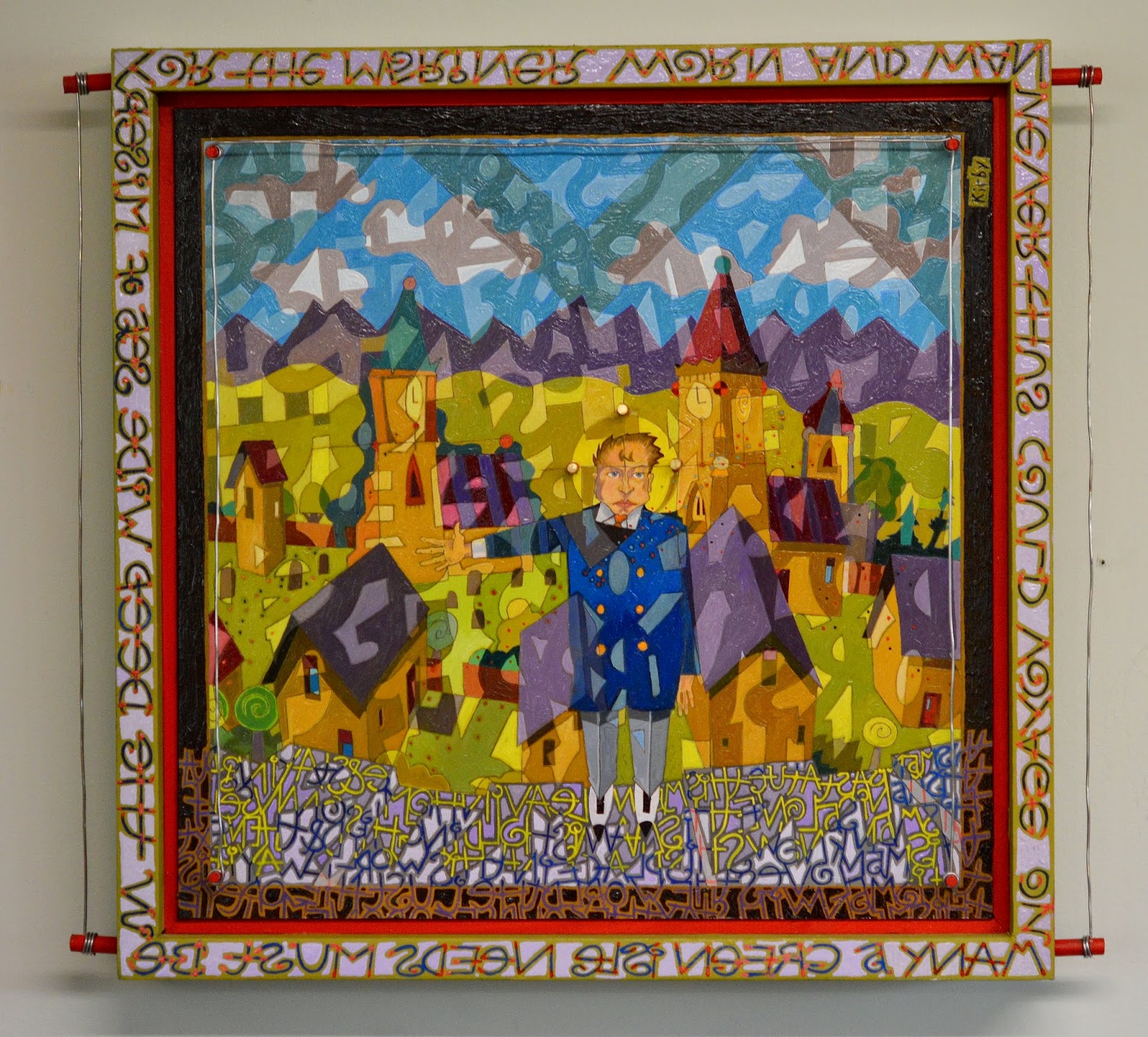
Here is an example of my 3-dimensional work which I just make the barest bones of a sketch idea and the rest is worked out as I build and paint the piece. It is somewhat ironic that these works are actually much more complicated and yet I don't seem to have an inclination to work out the details on paper. Instead, I think about these piece for a lot more time, working out most of the details in my head. Of course work like this is a much bigger commitment and this particular work is over 400 hours in the making.


These are just a few examples of the process from sketch to finished work. I am sure every artist has their own stories of success and failure when it comes to this process. It seems to me, after many years of experience, that every person has their own "natural" sense of colour and style which comes out in their art work without thought or plan. Some artist have a knack for doing very slick, commercially popular work (I don't mean this in a derogatory way) and they have certain advantages when it comes to certain kinds of work. Other artist may have a quirky charm about what they do, which may make commercial success more challenging but can also find a place. But regardless of your natural sense of colour and style, I think this problem of turning a sketch into a finished work is a universal dilemma.
Subscribe to:
Posts (Atom)